How Do I Empty My Reverse Osmosis Tank in Long Beach?
Draining an RO tank is one of the easiest maintenance jobs in your home, and knowing how to do it helps you spot small problems early.
How do I empty my reverse osmosis tank?
To empty your reverse osmosis tank, close the valve that feeds water to the RO system, then open the RO faucet at your sink and let it run until the flow drops to a slow drip. Close the faucet, reopen the feed valve and give the tank a few hours to refill.
Step by step: draining the tank
You do not need tools for a basic drain. Most under-sink systems have a small shutoff on the cold water line that feeds the RO unit, often a quarter-turn valve or a small knob on a saddle valve. That is the one you close, not the main cold water valve for the kitchen faucet.
Plan on several minutes of running water. A full residential tank holds a few gallons, and the stream starts strong, then slows as the air pressure inside the tank pushes out the last of it.
- Close the feed valve that supplies the RO system.
- Open the RO faucet (the small separate faucet at the sink) all the way.
- Let it run until the stream becomes a trickle or a drip. Water down the sink is fine, or use a bucket and water your plants.
- Close the RO faucet.
- Reopen the feed valve and let the tank refill before drinking from it again.
When should you empty an RO tank?
You do not need to drain it on a schedule. There are a handful of times when it makes sense, and each one has a simple reason behind it.
After a filter or membrane change, the first tank can carry carbon fines or the preservative some membranes ship with. Draining it once clears the system. After you have been away for a week or more, the water has been sitting in the tank and lines, and a fresh tank simply tastes better. If your water starts to taste flat or a little stale, a drain and refill is the first thing to try.
- Right after new filters or a new membrane
- After a trip or any stretch the system sat unused
- When the water tastes stale or slightly off
- Before checking the tank's air pressure
Why won't my RO tank drain, or why does it drain so slowly?
If you open the faucet and get a weak stream that quits fast, the tank usually has lost its air charge. Inside the tank, a rubber bladder separates the water from a pocket of air. That air does the pushing. When it leaks down over time, the tank fills with water but cannot push it out.
Another common cause is a valve on top of the tank that got bumped closed during a filter change. Check that the tank valve lines up with the tubing, which means open on most models.
If the tank feels heavy even after you have drained it, water may be trapped on the wrong side of a torn bladder. That tank is waterlogged, and replacing the tank is the honest fix. Adding air will not help for long.
Checking the air pressure while the tank is empty
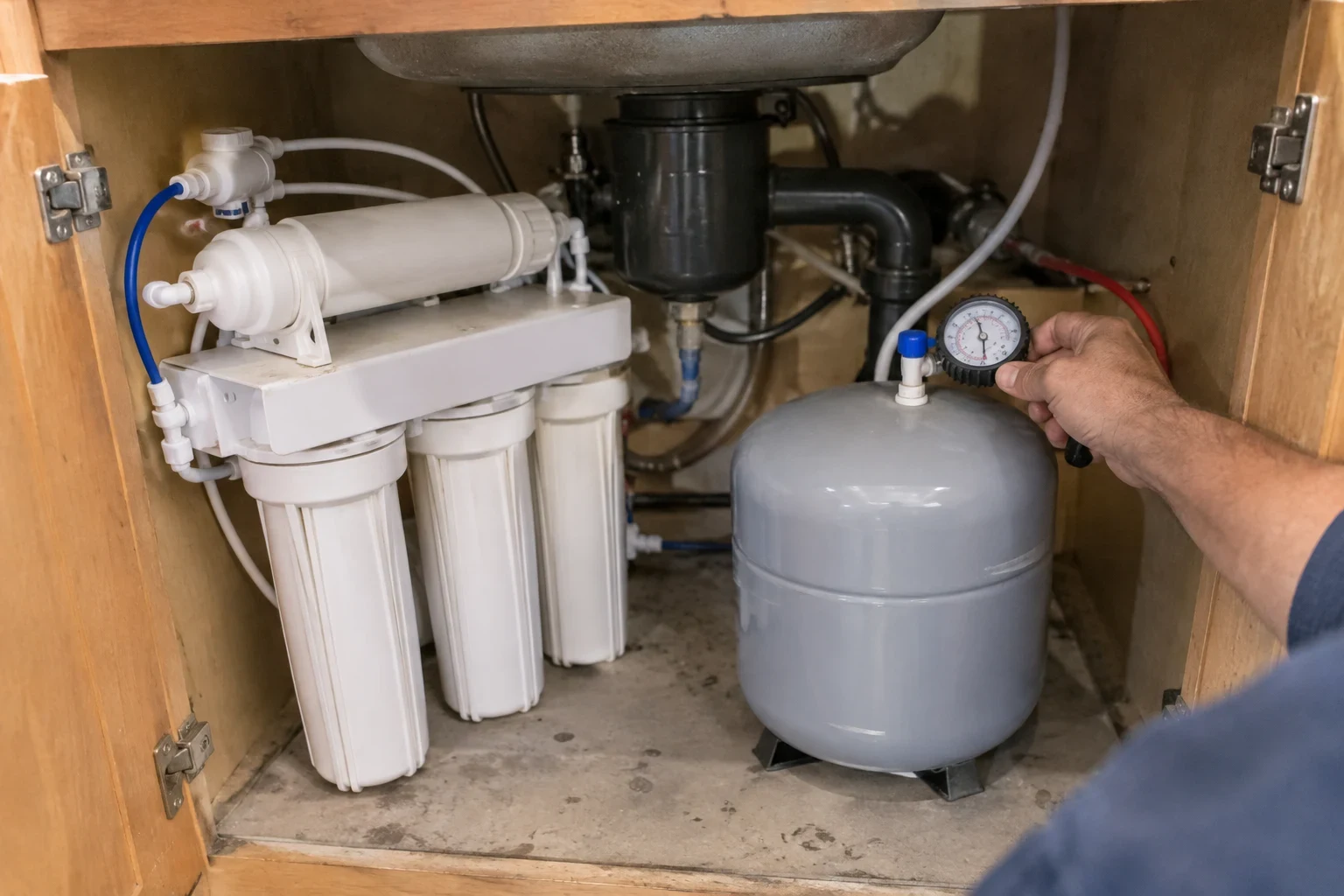
An empty tank is the only time you can get a true pressure reading. Look for a small valve, like a bike tire valve, on the side or bottom of the tank, usually under a plastic cap. A low-pressure tire gauge works for the check.
Many residential RO tanks are set around 7 psi when empty, but go by the label on your own tank. If the reading is low, a bike pump can bring it back up. Add air in short bursts and recheck, since it only takes a little. If the pressure drops again within days, the bladder is likely failing.
What happens after you refill
Refill time depends on your incoming water pressure and the age of your membrane, but a few hours is typical. Overnight is easiest. Some homes in the Long Beach area see slower refills when house pressure runs on the low side, and an RO system makes water more slowly in that case.
Once the tank is full, look under the sink for drips at the fittings you touched. A quick check now saves a damp cabinet floor later. If refills keep taking longer than they used to, your filters or membrane may be due for a change.
More questions about RO tanks
Will draining the tank harm my membrane or filters?
No. Draining only empties stored water. The membrane and filters stay wet in their housings, and the system starts producing again as soon as you reopen the feed valve.
Do I have to shut off water to the whole kitchen?
No. Only the small valve that feeds the RO unit needs to be closed. Your regular kitchen faucet keeps working the whole time.
Is the first water after a refill safe to drink?
Yes, once the tank has refilled the water is ready to use. After a filter change, many people drain that first full tank once more for the best taste.
How do I know my tank needs replacing instead of more air?
If it feels heavy when empty, loses pressure within days of adding air, or water comes out of the air valve, the bladder has failed and a new tank is the better choice.
Tank still giving you trouble?
Give us a call and tell us what your RO system is doing. We will help you sort out whether it needs air, a new tank or a new system. New reverse osmosis systems come with free install (we cover the cost).